What Lies Beneath the Words
When a person speaks, they rarely say first what it is about. They say: I can’t go on. I don’t know what to do. It’s too much. What lies beneath–the feeling, the meaning, the person themselves–only shows itself when someone listens in a way that allows it to show itself.
That is what the two charts on this page are about. They follow the same map that carries a whole conversation in Staying With: I hear you. I understand you. I wonder at you. I wonder with you. The first chart walks this way with seventeen feelings–up to the question of what happens when a feeling is allowed to be here for a moment. The second walks it with particular life situations–up to the question of what happens when a reality is allowed to be true for a moment.
Neither chart is a set of instructions. They are reminders of a way of being: that no one has to justify their feeling, and no one has to defend their reality, for someone to stay with them.
Of this way of being, Staying With tells.
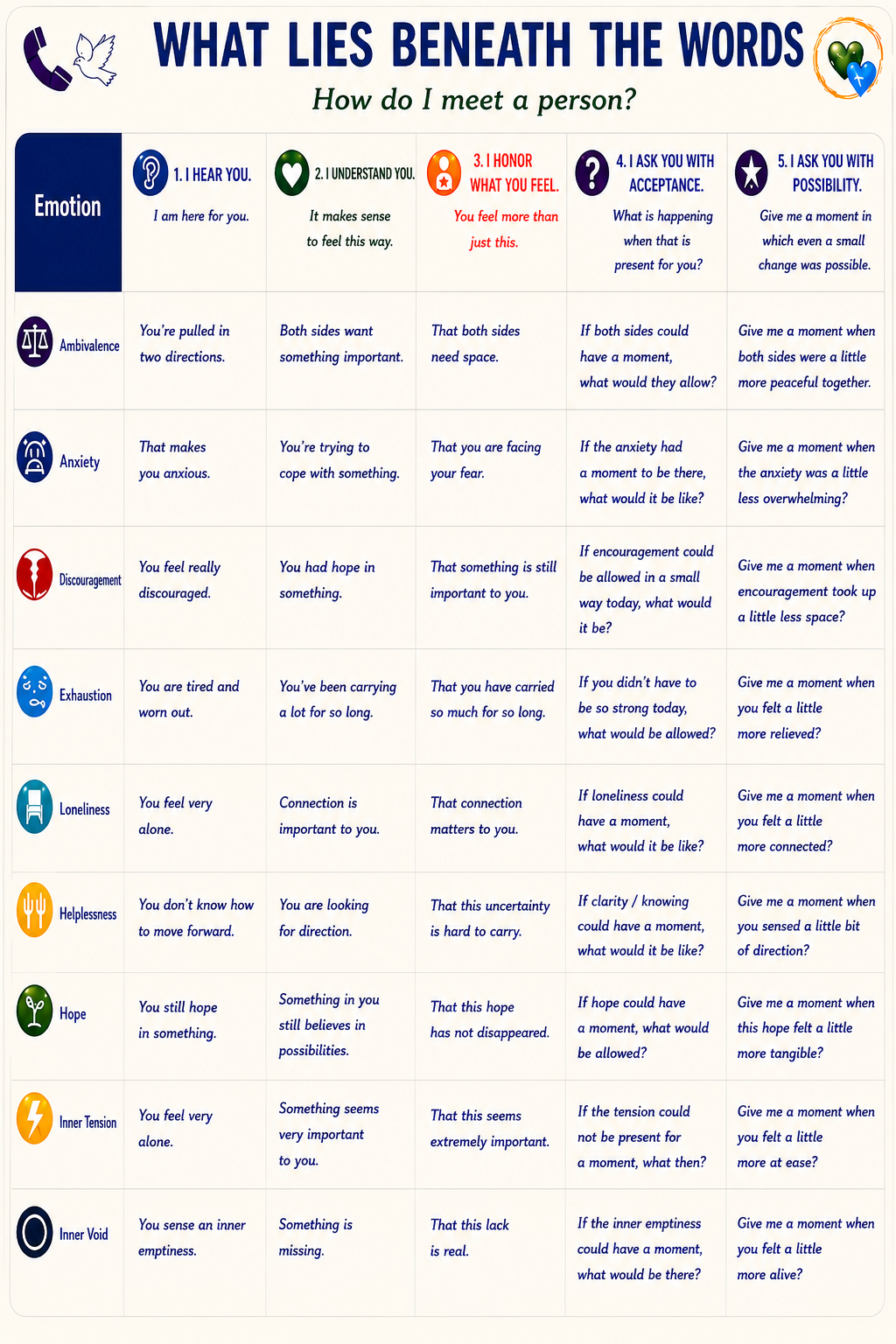
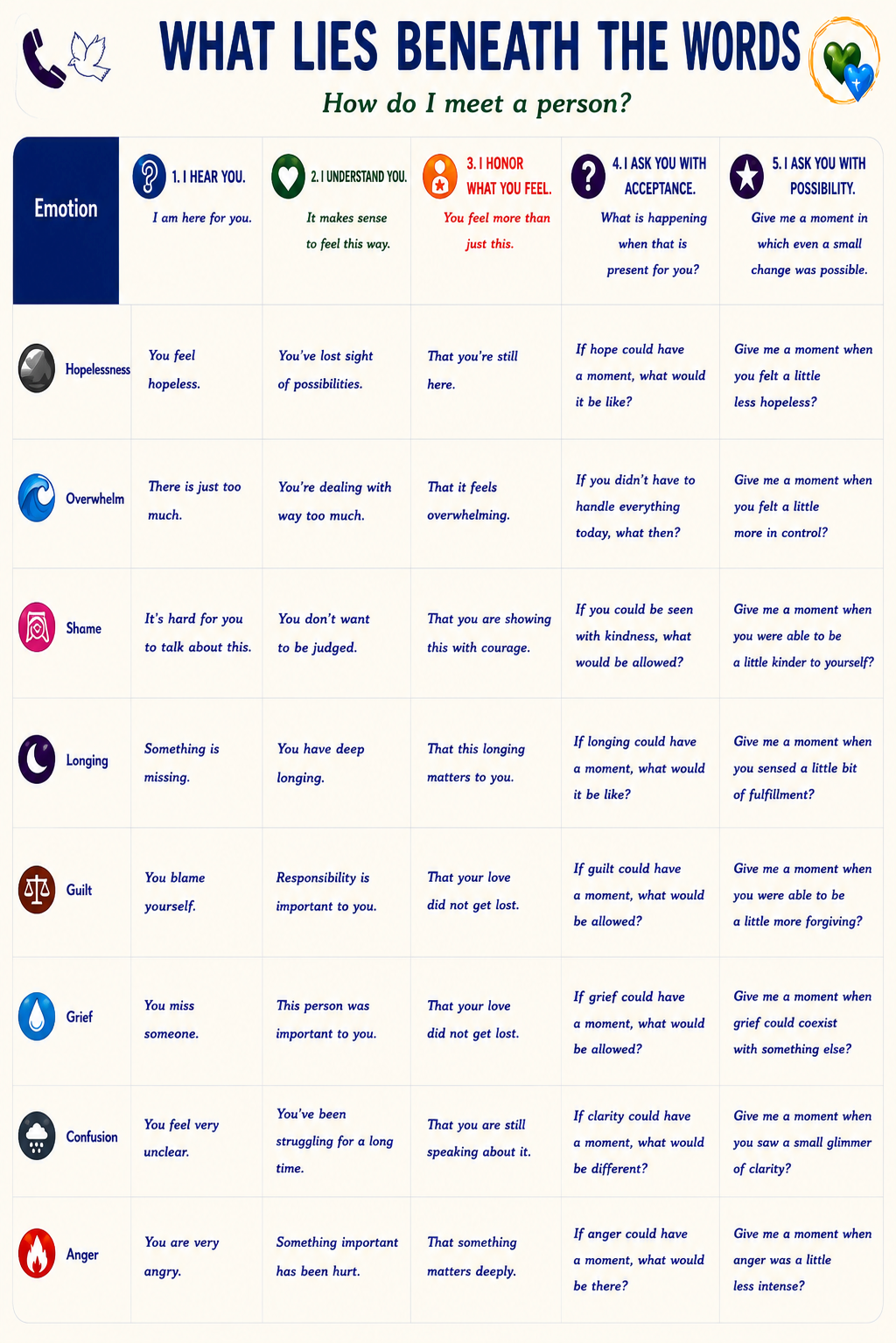
What Lies Beneath the Words - Feelings
Seventeen feelings, five columns. But this chart is not a collection of techniques, and its sentences are not formulas. They are directions of looking. From left to right, every row repeats the same movement: I hear you. I understand you. I wonder at you. I wonder with you. From feeling to meaning, from meaning to the person, from the person to acceptance–and only then, last of all, to possibility.
The heart of the chart is the fourth column: What happens if what is here right now is allowed to be here for a moment? This question was not invented for the chart. It comes from Staying With, from the conversation that unfolds the map of meeting there: Marta asks Werner, who is fighting his illness–‘What happens if the illness is simply allowed to be here for a moment?’ The book says of it: this was not surrender. It was an invitation to let the fighting rest for a moment. The chart now spells this one invitation out through seventeen feelings–the anxiety may be here a moment longer, the discouragement does not have to grow smaller today, the grief may stay. Nothing has to go away. That is the whole difference.
Between the fourth and the fifth column lies something the chart cannot show–and the book names it. There, on the map, is a field without a number: discovery. It cannot be aimed at. Marta did not summon Werner’s decisive sentence–she received it. Only after that does the fifth column become possible, the quietest of all questions about change: Was there a moment, even a small one, that was different? Whoever knows the six questions for the unavailable will recognise their conversational shape here: the acceptance column is the Welcoming Question in an everyday voice, the possibility column the gentlest form of the solution-focused question about what is already there.
Seventeen feelings, five movements–and beneath them all a single way of looking:
Accompanying someone is the art of looking in a way that allows a person to begin to see themselves again.
On the book: Heiko Raue, ‘Staying With. A Way of Being Present in Crisis, Pastoral Care, and Accompaniment’, 2026.
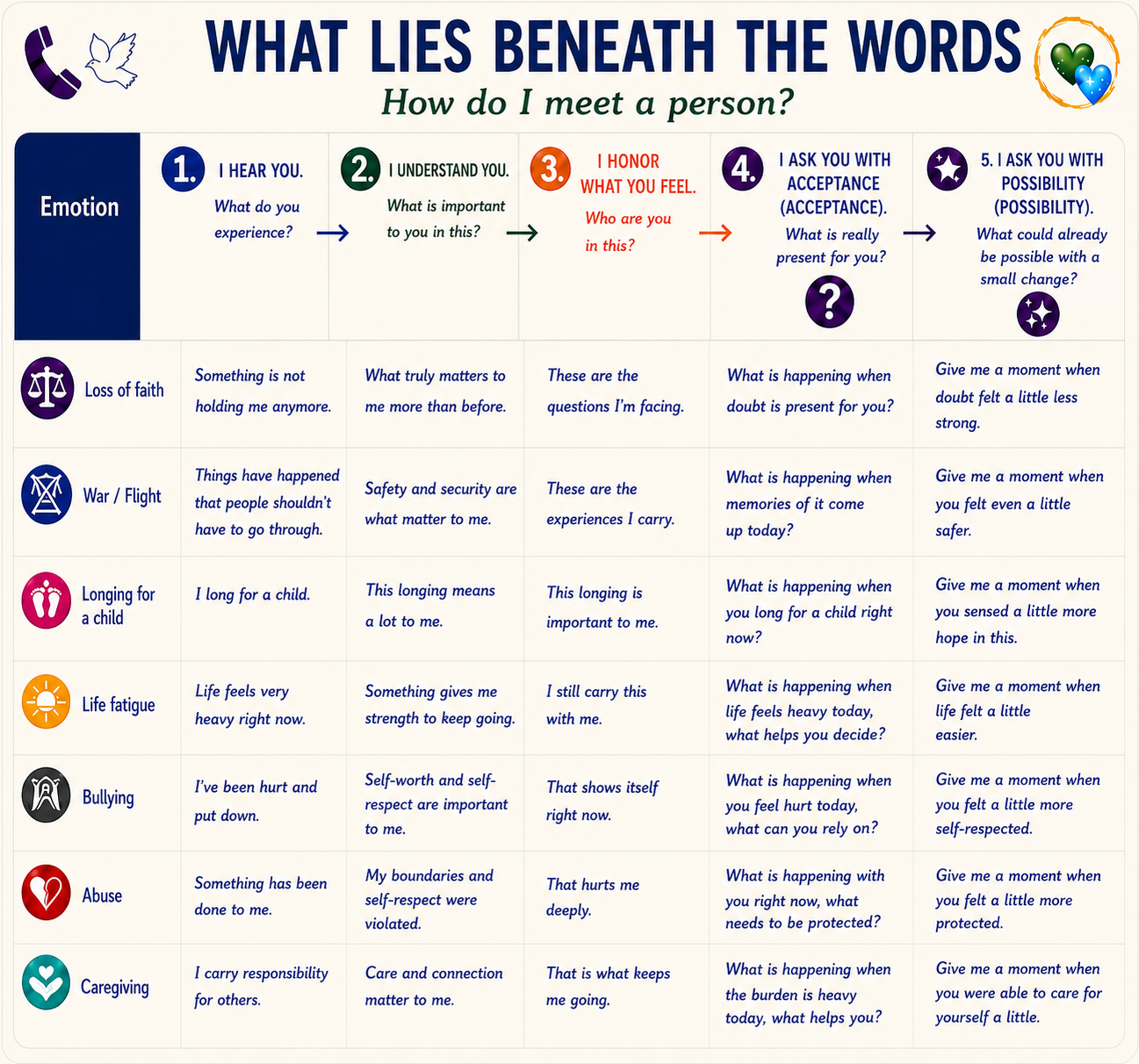
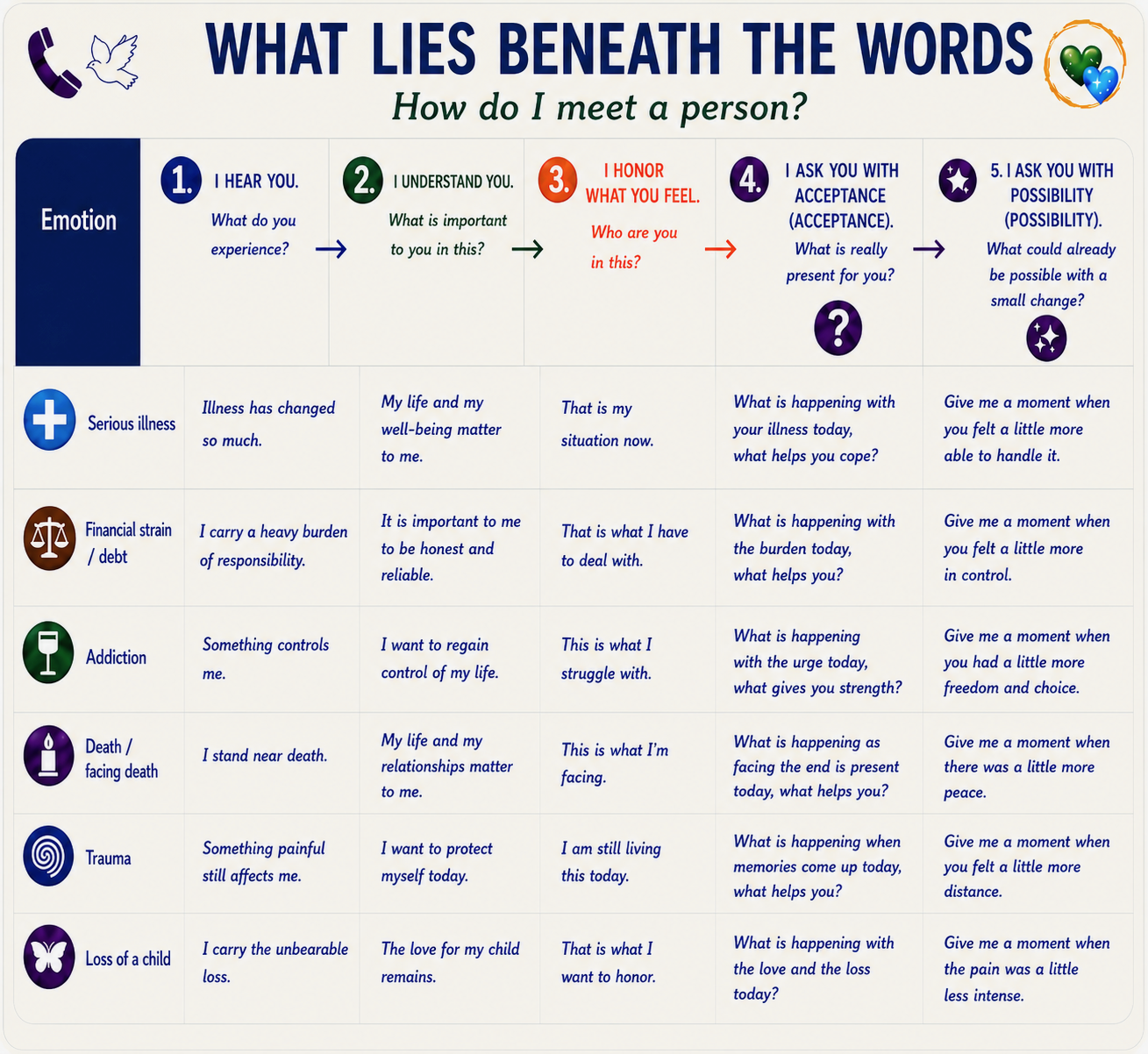
What Lies Beneath the Words - Life Situations
The first chart asks about feelings. This second one asks about life situations–loss of faith, war and flight, abuse, caregiving, addiction, dying, the loss of a child. About realities, then, that cannot be dissolved and cannot be talked nice. And so, in the fourth column, a single word changes, the decisive one: allowed to be here becomes allowed to be true.
That word carries weight. For whoever lives in such a situation often carries twice: the reality itself–and the struggle for it to be allowed to be true. Those around them relativise, correct, comfort it away; well meant, and yet a second burden. In Staying With, Marta does the opposite at this point, and the book holds it in three short sentences: she allowed this reality to stand. She did not correct it. Did not relativise it. That is exactly what the question What may be true? does–it lifts the second struggle for a moment. The reality does not become lighter by it. The person does.
Whoever reads the chart closely will find, in almost every acceptance question, a second half: without having to be explained, without having to be fought, without having to be decided, without having to be answered. These protective clauses are the true core of the chart. They are the stance that carries its own chapter in the book–What You Do Not Have to Earn–and that finds its shortest expression in the portrait of Siegfried Essen: ‘You do not have to tell anything. It is yours all the same.’ The chart carries this sentence over into questions. Precisely in its heaviest rows lies the protection: nothing has to be decided, nothing proven, nothing explained. Something may be true–and the person is not left alone with it.
This chart makes none of these realities lighter.
It allows them to be true–and leaves no one alone with them.
On the book: Heiko Raue, ‘Staying With. A Way of Being Present in Crisis, Pastoral Care, and Accompaniment’, 2026.