Making the Unavailable Available
Some things in life cannot be manufactured. Not sleep, not trust, not comfort, not change. The more firmly we reach for them, the further they withdraw.
And yet we are not at the mercy of the unavailable. There are questions that do not grasp but invite–questions that open a door and then wait for what may enter. Six such questions are gathered on these pages: four from the solution-focused and systemic tradition, one after Viktor Frankl, one after Stephen Gilligan. All of them begin with the same quiet word: Imagine.
What they need in order to work is no special skill. It is a space in which someone is there and stays.
Of this space, Staying With tells.
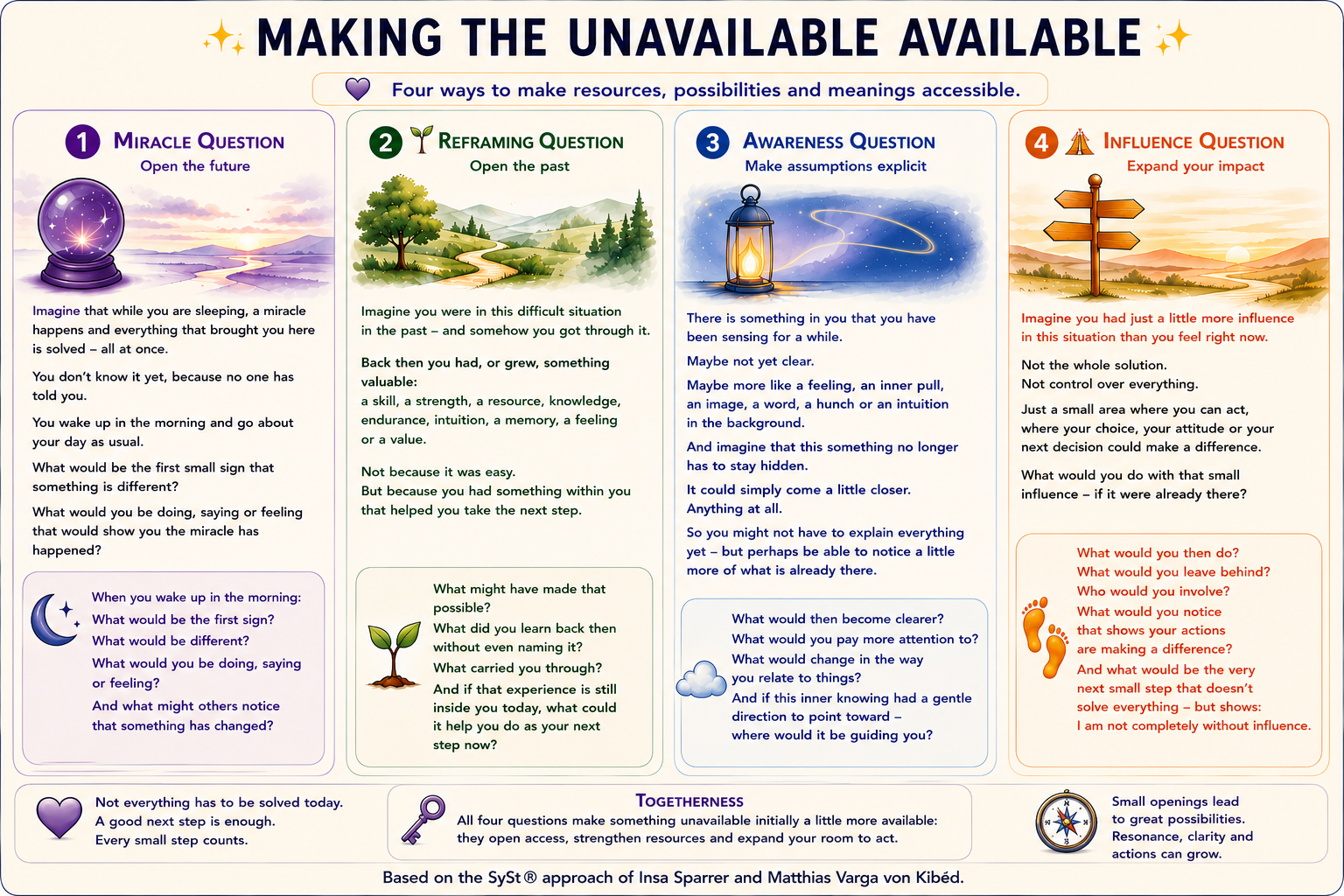
Making the Unavailable Available
The chart shows four questions. Four directions, one movement.
The Miracle Question looks towards the future–not as a goal, but as a state you may step into for a moment, without yet knowing the way there. The Reframing Question looks towards the past–not to soften it, but to sense that in a difficult time something may also have grown that holds today. The Awareness Question looks inward–towards what you have been sensing for a while and cannot yet grasp. And the Influence Question looks at your own acting–at the small area where a decision, a doing or a letting-be could make a difference.
All four begin with the same word: Imagine.
This word demands nothing. It claims nothing. It invites you, for a moment, to look as if something were possible that only just seemed out of reach–a miracle, fertile ground where the earth seemed scorched, a hunch growing clearer, an influence that is already there. None of it has to be believed. It may simply come a little closer.
And this is exactly where these questions touch what Staying With is about.
For a question is only as good as the space in which it is asked. The same words can open or close–depending on whether someone is truly there while speaking them. The four questions presuppose what the book describes: that someone holds before someone asks. That respect, genuine interest and trust are not techniques, but a stance from which questions like these can arise in the first place. Ask the Miracle Question as a tool, and you receive an answer. Ask it out of accompaniment, and you open a space.
And something else connects the two. Beneath the chart stands a sentence that is easy to overlook: Not everything has to be solved today. A good next step is enough. That is, in other words, the keynote of the book: I am here. I stay with you. It holds. The four questions are not looking for a solution in the grand sense. They are looking for a small opening–and they trust that small openings can become something when someone stays.
Some of the voices behind these questions speak in the book itself: Steve de Shazer, from whom the Miracle Question comes; Milton Erickson, whose trust in the unconscious shapes them all; and Insa Sparrer and Matthias Varga von Kibéd, in whose SySt approach the four questions have become a family. In the chapter The Voices Behind they stand side by side–as people who each, in their own way, discovered the same thing: that change is not forced, but invited.
The questions make the unavailable a little more available.
Accompaniment makes the space in which that may happen.
Based on the SySt® approach of Insa Sparrer and Matthias Varga von Kibéd. On the book: Heiko Raue, ‘Staying With. A Way of Being Present in Crisis, Pastoral Care, and Accompaniment’, 2026.
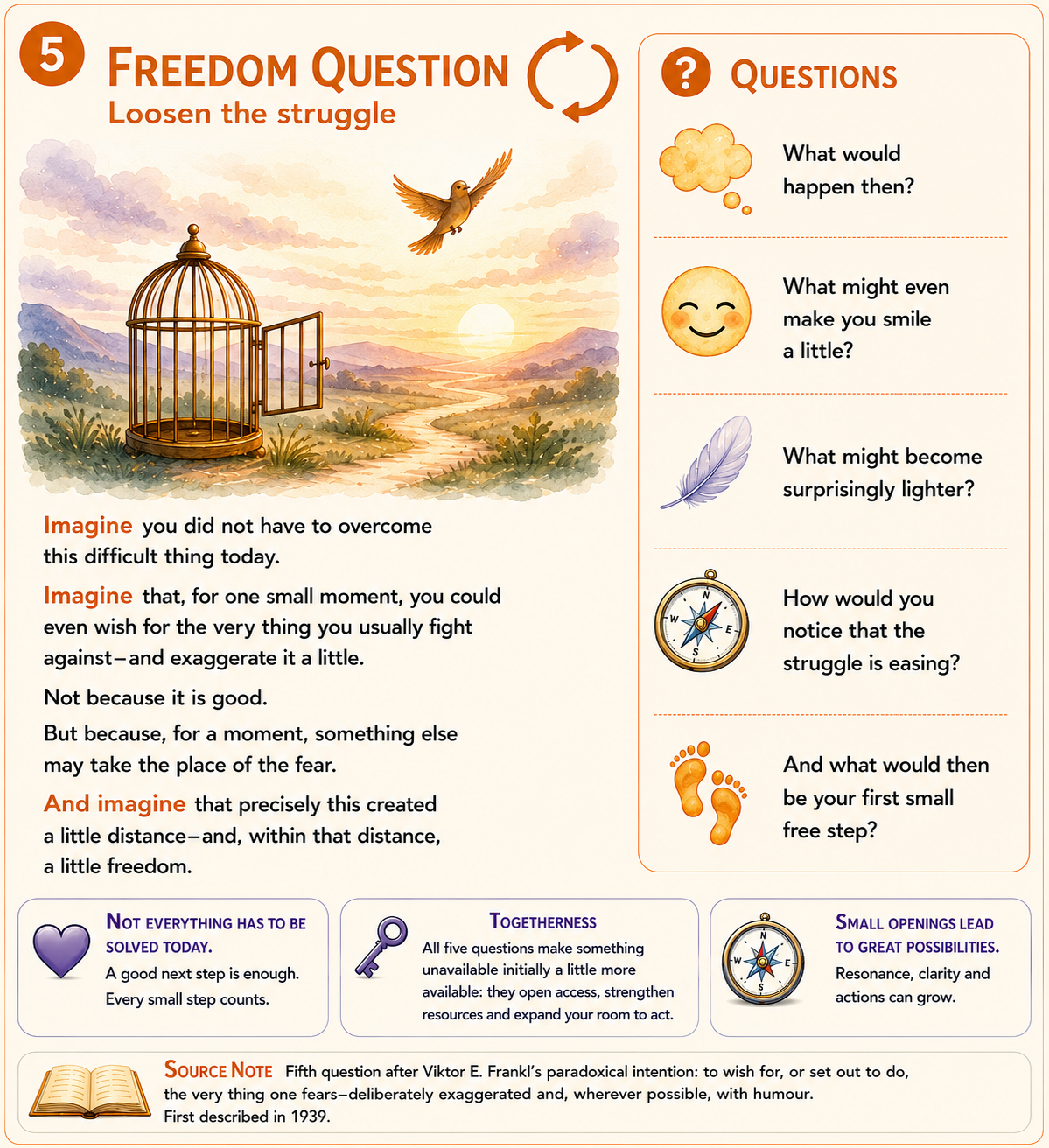
The Freedom Question
The four questions open spaces: the future, the past, the inner life, our acting. The fifth question does something else. It does not change where we look–it changes how we stand towards what weighs on us.
For some things do not grow lighter because we fight them. They grow heavier. The struggle binds the very strength that life would need. The Freedom Question invites us to loosen that struggle for a moment. Not to overcome the difficult thing–but, for a moment, no longer to have to keep it away. Perhaps even, with a small wink, to wish for it a little. Just for fun. Just to see what happens.
Behind this invitation stands Viktor Frankl. He called the stance it comes from paradoxical intention: to wish, for a moment, for the very thing one fears–deliberately exaggerated and, wherever possible, with humour. The humour is not decoration. It is the way. Whoever can smile a little at their own burden is no longer entirely at its mercy. A small distance appears. And within that distance: a little freedom.
In Staying With, Frankl has a voice of his own, in the chapter The Voices Behind. There he marches through snow–a prisoner from whom almost everything has been taken. And in the middle of the camp he discovers that something remains: the presence of love, dignity, meaning. A human being is greater than what happens to them. The Freedom Question is the small, everyday sister of that great experience. It does not claim that the hard thing is good. It only reminds us that we are not nothing in the face of it.
And as with the four other questions: everything depends on the stance from which it is asked. A smile can be invited, never demanded. It appears where someone is there and stays, without pressing–where the hard thing may be present for a moment without crushing. And the question has a limit that Frankl himself drew: it is a question for the struggle with fear–not for deep despair. There, no wink is needed. There, what is needed is simply: staying with. I am here. I stay with you. It holds.
The Freedom Question does not make the hard thing smaller.
It makes the human being a little greater again than what happens to them.
After Viktor E. Frankl’s paradoxical intention (first described in 1939). On the book: Heiko Raue, ‘Staying With. A Way of Being Present in Crisis, Pastoral Care, and Accompaniment’, 2026.
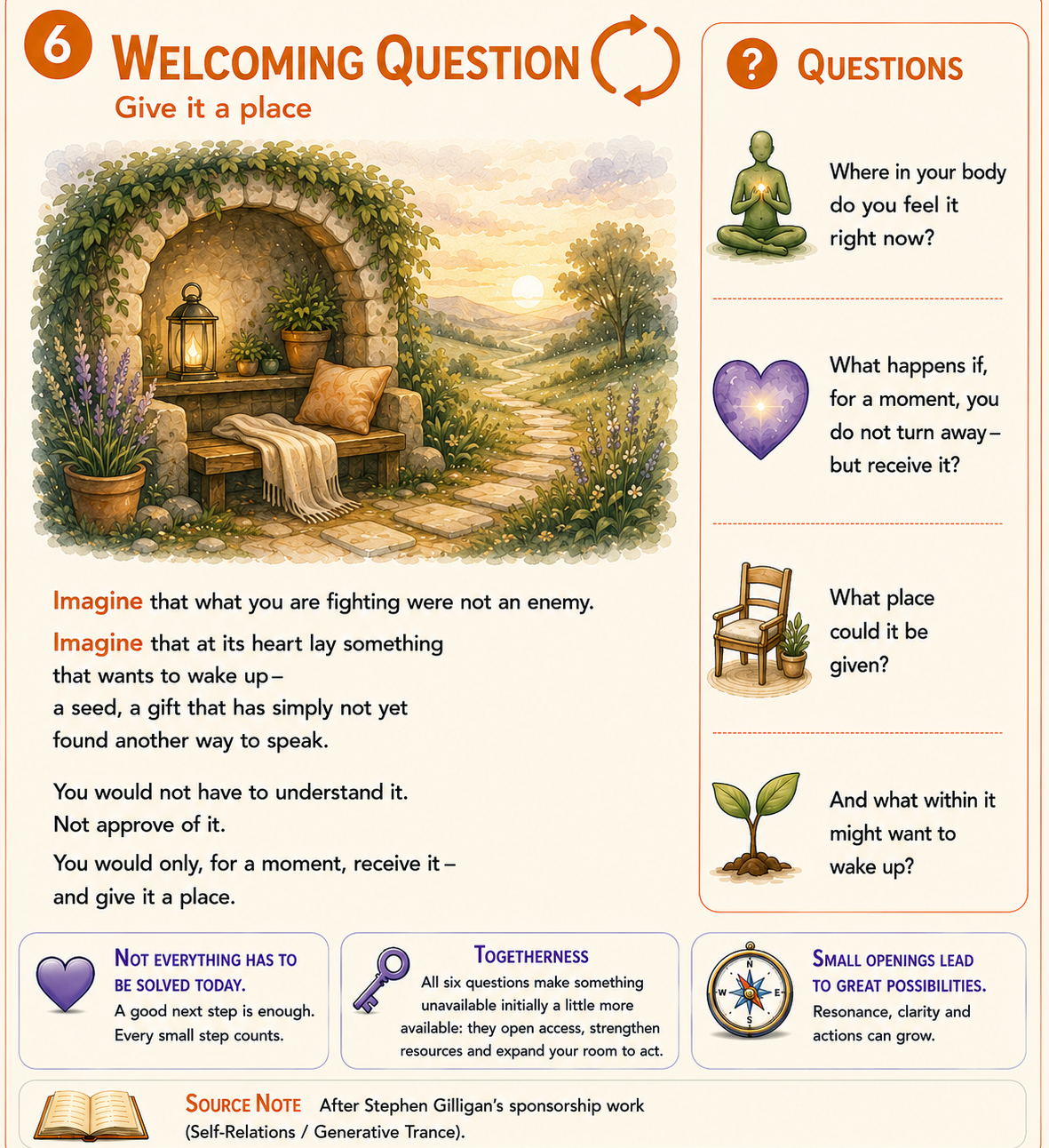
The Welcoming Question
The picture on this card shows no person. It shows a place. A bench in a sheltered alcove, a cushion, a blanket, a lantern already lit. Everything is ready–for something that has not yet arrived. That is the Welcoming Question: not a tool, but a place made ready.
For it, too, begins with the experience the Freedom Question knows: the struggle feeds what it fights. But where the Freedom Question loosens the struggle with a wink, the Welcoming Question takes the quieter path. It suggests no longer seeing what we fight as an enemy–but as something at whose heart lies a seed, a gift that has simply not yet found another way to speak. You do not have to understand it for that. Not approve of it. Only, for a moment, receive it–and give it a place.
Behind this invitation stands Stephen Gilligan. Receive it, bring it into sanctuary, give it a place–these are his own words, almost a liturgy. And behind them his conviction that at the heart of even the most difficult behaviour something good is trying to wake up. This is no trivialising: Gilligan never claims that the content of the hard thing is good. He only claims that its core can be addressed–and that fighting it is precisely what keeps it out of reach.
In Staying With, Gilligan has a voice of his own, in the chapter The Voices Behind. The portrait tells of a man who calls himself a pervert–and of what happens in Gilligan before he answers: an old inner visitor appears, Father McCarthy, the priest of his childhood, who knows at once what is to be done. And Gilligan does the astonishing thing: he does not fight the voice. He thanks it–and bids the old priest a friendly farewell. Only then can he hear the man differently. No longer the symptom, but: Something is trying to wake up. The Welcoming Question, then, is asked inward first, to our own quick voices–and only then to the other person. Or, in Gilligan’s sentence from the book: ‘Something is looking for a human presence that will treat it kindly and respectfully.’
Perhaps that is the deepest reason this question belongs with the book. In the coda of the chapter, each voice is given a single verb. For Gilligan it reads: Stephen Gilligan receives. And right beside him stands Siegfried Essen–What Is Freely Given–with a woman who did not have to tell her story in order to be helped. The bench in the picture is both at once: the place that stands ready, and the place that does not have to be earned. I am here. I stay with you. It holds.
The Welcoming Question does not turn the hard thing into something good.
It gives it a place–so that what is waiting inside may wake up.
After Stephen Gilligan’s sponsorship work (Self-Relations / Generative Trance)