The Room of Looking
A way of being can be described. It can also be entered. The texts on this page do the second: they lead into Staying With as into a room–two windows, a chair, a cup–and show what moves within it.
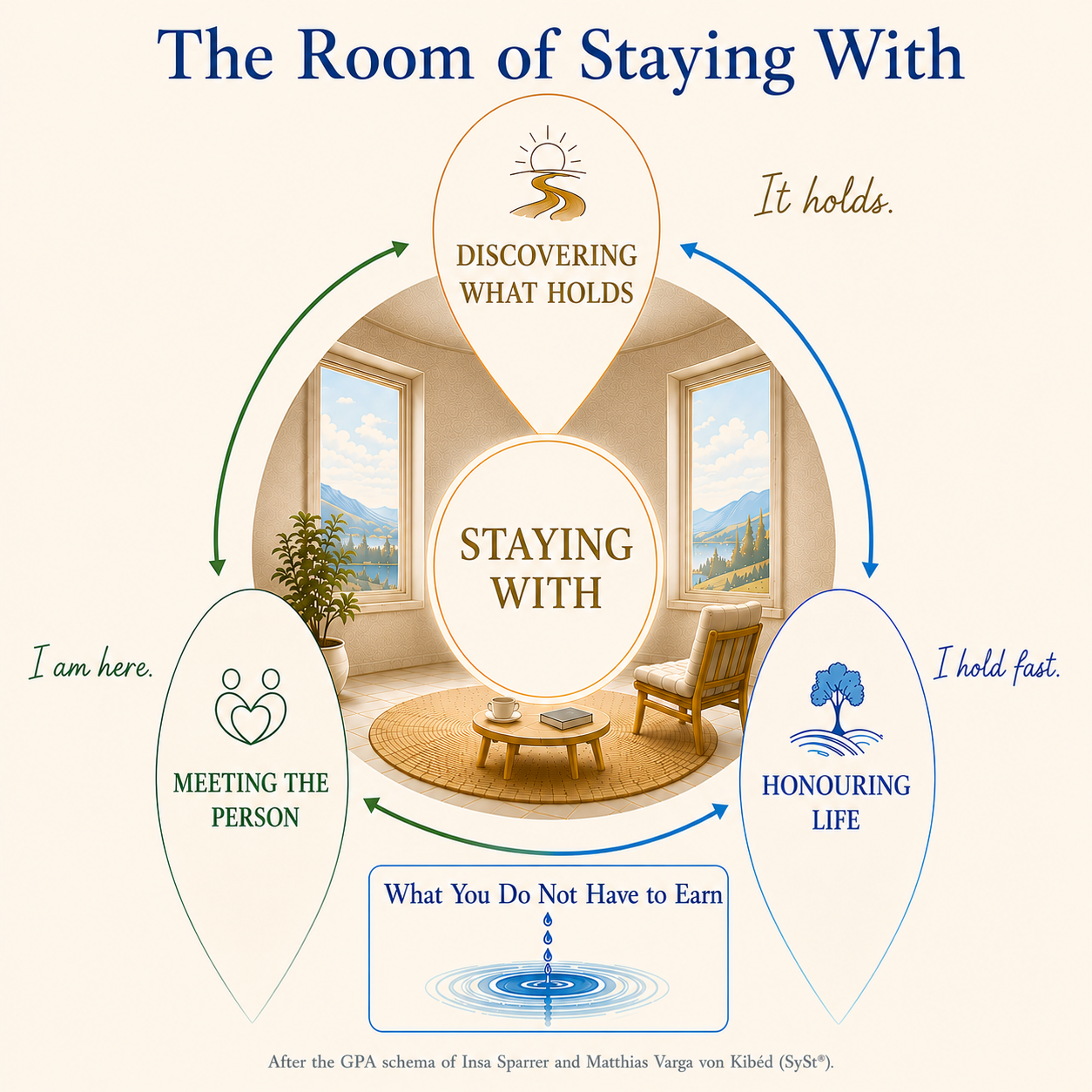
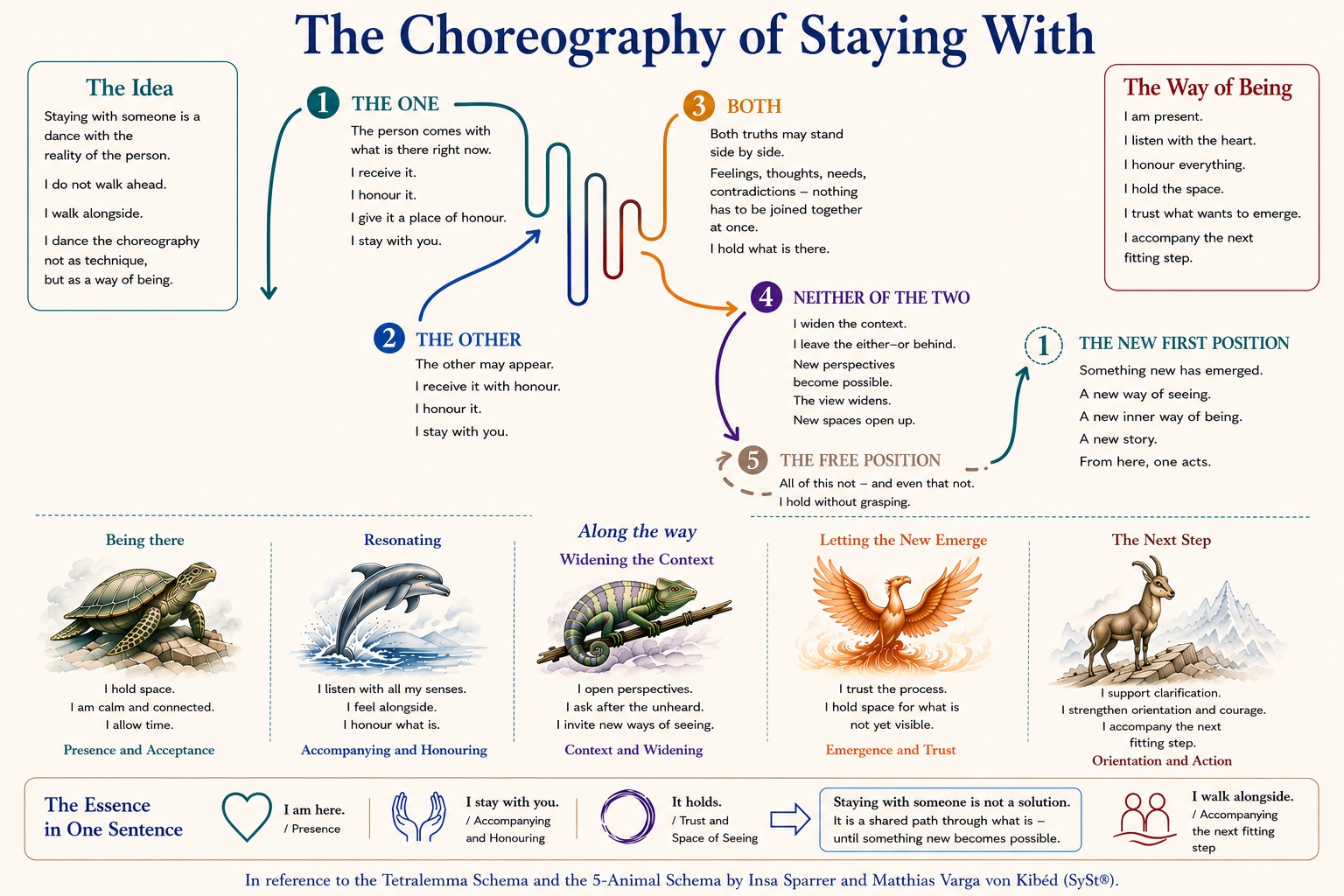
The first text enters this room and finds three doors, one for each sentence of the leitmotif. The second describes its choreography: the dance with a person’s reality–from the one, by way of the other, to where the gaze becomes free–accompanied by five ways of being present, from the calm of the turtle to the sure-footedness of the chamois. The third gathers the four basic movements from which helpful conversations can arise. And the last two introduce the sources from which this way of being has grown: Stephen Gilligan’s four pillars and the four principles of Systemic Structural Constellations by Insa Sparrer and Matthias Varga von Kibéd.
None of these texts teaches a technique. They all practise the same way of looking–the one from which this room takes its name: accompanying someone is the art of looking in a way that allows a person to begin to see themselves again.
Of this way of looking, Staying With tells.
When I enter the room of Staying With …
When I enter the room of Staying With, I first set something down: the idea that I have to accomplish anything here. The room is simple. Two windows, a chair, a cup. Nothing in it is method. Everything in it is invitation.
Three doors lead further in. Meeting the person – I am here: here I meet the one who comes, in their dignity. Honouring life – I hold fast: here I stay true to reality and make life neither smaller nor lighter than it is. Discovering what holds – It holds: here I turn my gaze to what is already there and holds – often no more than a small difference.
And in between waits what you do not have to earn: A sentence holds. A silence holds fast. A new way of seeing arises. Something happens – and we may marvel.
For it is not the accompanist who solves. Not the accompanist who knows. Not the accompanist who heals. He is here. He holds fast. He sees what holds. And remains human.
The Choreography of Staying With
Staying With is a dance with the reality of the person. I do not walk ahead. I walk alongside – not as technique, but as a way of being.
The person comes with what is there just now: the one. I receive it, honour it, give it an honoured place. Then the other may appear, and I receive it in the same way. Both may stand side by side – feelings, thoughts, contradictions; nothing has to be joined at once. Sometimes the view then widens: neither of the two – new perspectives become possible, room to move opens up. And at times the free position opens: none of this – and not even that. I hold without grasping. From there, something new arises – a new way of seeing, a new story. From here, action is taken.
Along this way, five ways of being present accompany me: the calm of the sea turtle, holding space and allowing time; the resonance of the dolphin, listening with all its senses; the wide gaze of the chameleon, asking after what has not yet been heard; the trust of the phoenix in what is not yet visible; and the sure-footedness of the chamois for the next fitting step.
And through it all, the essence: I am here. I hold fast. It holds. For Staying With is not a solution. It is a shared way through what is – until something new becomes possible. I walk with, until the next fitting step comes into view.
Staying With – Four Core Movements of a Way of Being
What makes a conversation truly helpful?
Not every meaningful encounter begins with the right question. Not every change begins with a solution. More often, it begins with something much simpler: the willingness to be genuinely present with another human being.
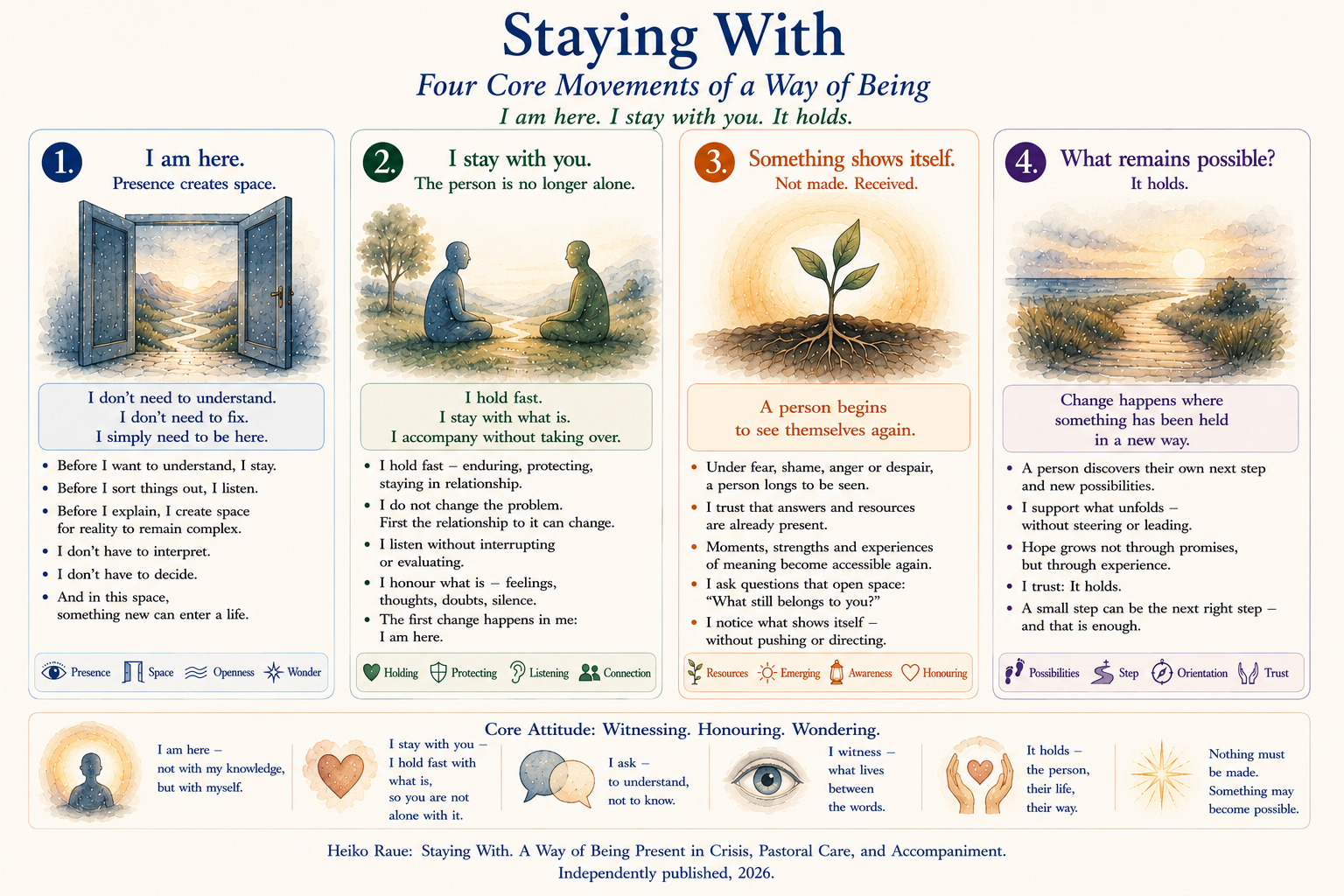
This illustration summarizes the four core movements described in Staying With. They are not a method or a sequence of techniques. They describe a way of being from which conversations of depth and dignity can naturally unfold.
I am here.
Accompaniment begins with presence. Before we seek to understand, explain, or solve, we create a space in which another person can simply arrive. What carries the conversation is not the accompanist’s expertise, but their presence.
I stay with you.
The external situation may remain unchanged, but the experience of facing it alone begins to shift. Fear, grief, anger, uncertainty, and silence are all allowed to be present. To stay with someone means to accompany without taking over, to remain without controlling, and to hold without grasping.
Something shows itself.
When nothing needs to be forced, something unexpected may quietly emerge. A forgotten strength, a deeper longing, a new understanding of oneself, or a possibility that had always been there but remained unseen. Such moments cannot be produced. They can only be received.
What remains possible?
From what has revealed itself, a next step sometimes becomes visible. Not a dramatic breakthrough, but a small and fitting movement that belongs to the person themselves. Change is not something we manufacture. It grows from a meeting in which someone begins to see themselves again.
These four movements are not stages to be followed in order. Conversations rarely move in straight lines. They circle, pause, return, and surprise us. What gives them coherence is not a technique but a shared quality of presence.
Accompaniment is the art of looking in a way that allows a person to begin to see themselves again.
The illustration offers an orientation for everyone who accompanies others—in pastoral care, counselling, psychotherapy, healthcare, education, leadership, coaching, or simply in everyday life. It is an invitation to trust that some of the most meaningful changes do not come from doing more, but from being more fully present.
Reference:
Heiko Raue: Staying With. A Way of Being Present in Crisis, Pastoral Care, and Accompaniment. Independently published, 2026.
Stephen Gilligan – The Four Pillars for Change and the Emergence of Something New
What allows something genuinely new to emerge?
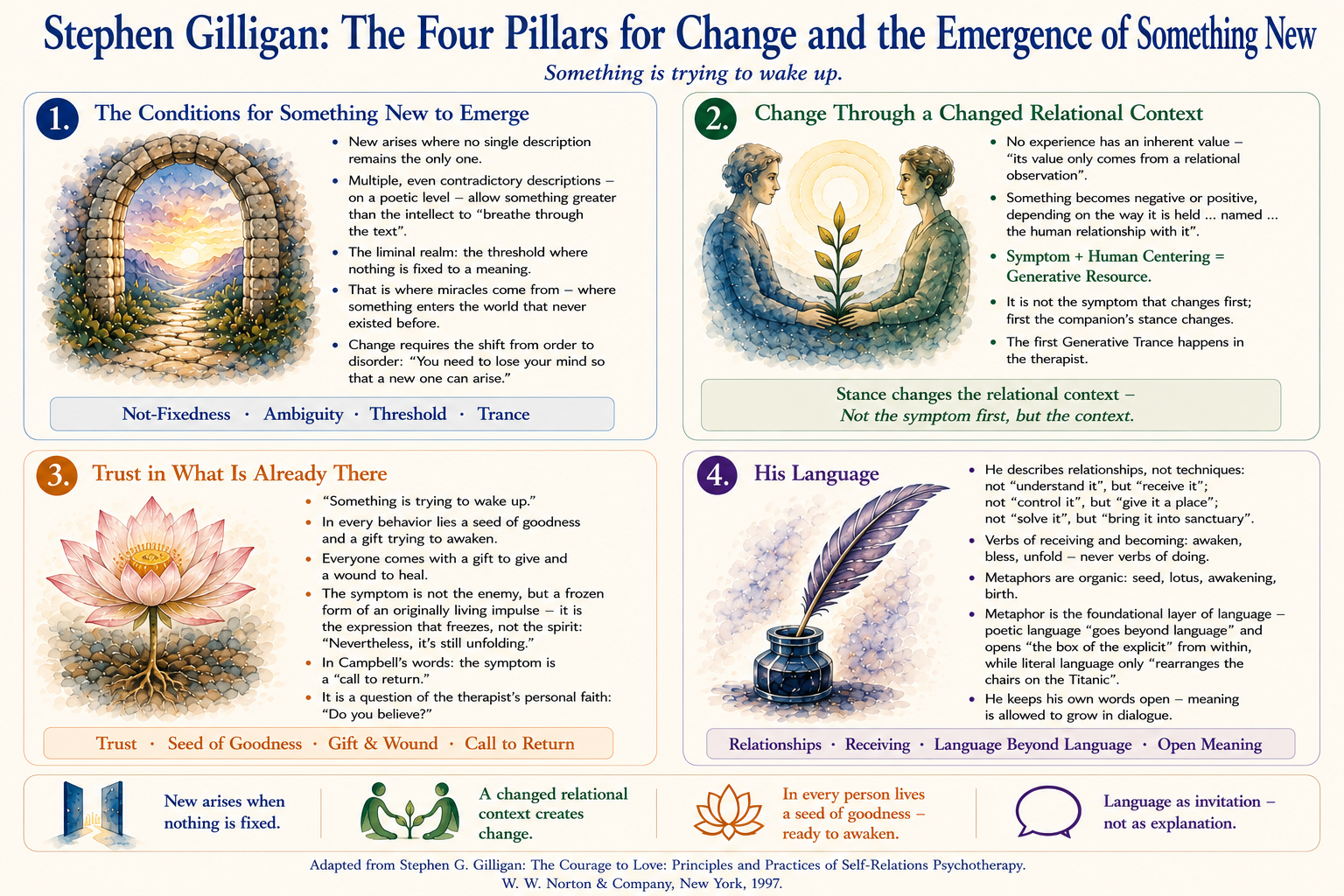
Stephen Gilligan, one of the leading developers of Generative Trance, understands change not as the result of control or technique, but as something that unfolds within a particular quality of relationship. Transformation begins when experience is received rather than judged, when uncertainty can be held instead of eliminated, and when a person is met with presence rather than intervention.
This illustration brings together four central themes of his work:
- New possibilities emerge when experience is not reduced to a single explanation and ambiguity can be held with openness.
- Change takes place within a relational context. Often it is not the symptom that changes first, but the way it is received and held.
- Every person already carries something alive within them. Gilligan trusts that even the most difficult symptoms may contain a healthy impulse waiting to awaken.
- Language shapes reality. Poetic images, metaphors, and words of blessing open doors that purely explanatory language often leaves closed.
These ideas have deeply influenced my own work and the development of Staying With. They remind us that accompaniment is not about producing solutions. It is about creating a space in which something new can quietly emerge—something that was already present, waiting to be seen.
Change is not something we make happen. It is something we make possible.
Reference: The Courage to Love: Principles and Practices of Self-Relations Psychotherapy. W. W. Norton & Company, New York, 1997.
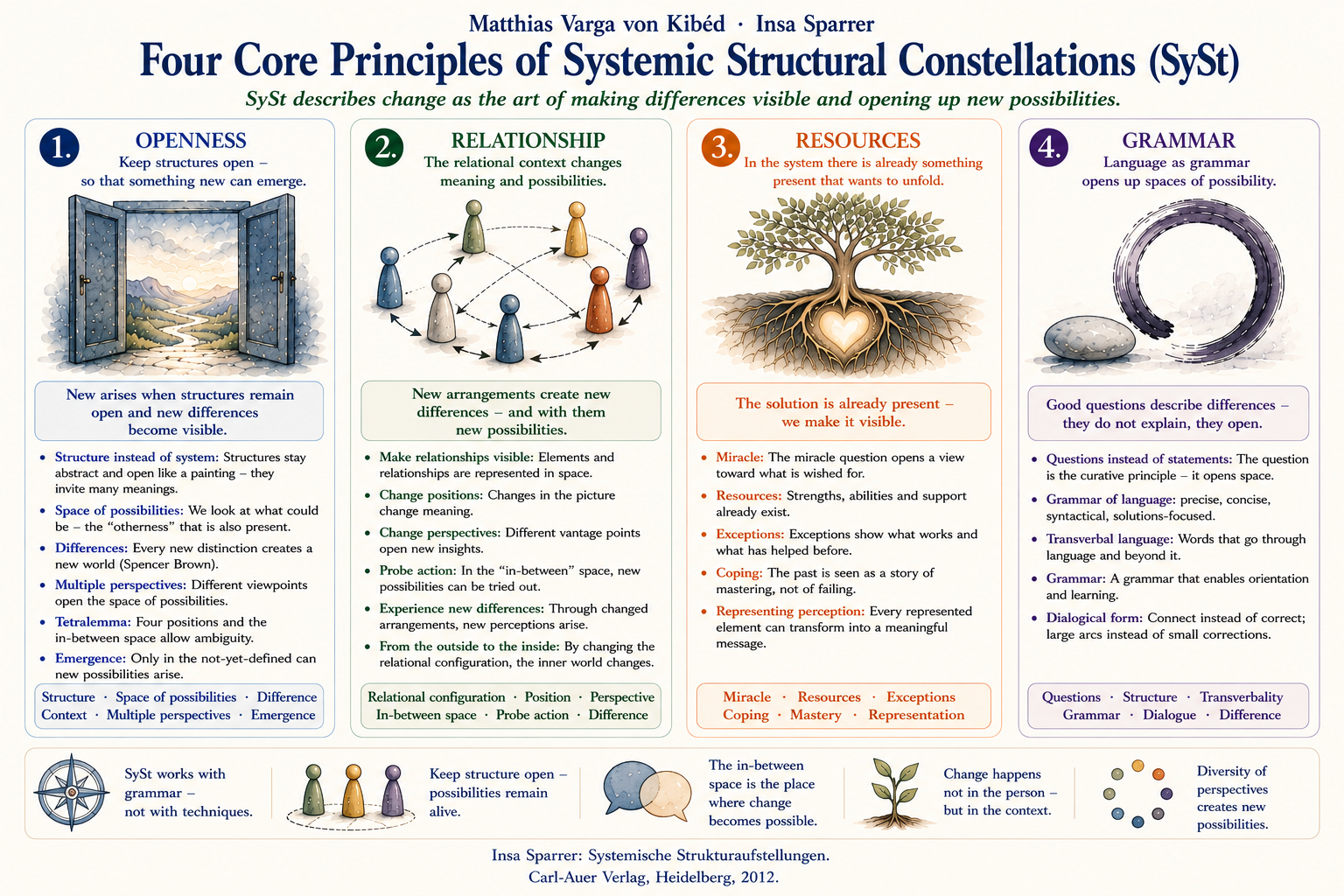
Systemic Structural Constellations (SySt) – Four Core Principles
What makes Systemic Structural Constellations (SySt) so distinctive?
Developed by Insa Sparrer and Matthias Varga von Kibéd, SySt is more than a method for facilitation or therapy. It is a way of understanding human systems through structures, relationships, distinctions, and possibilities rather than through fixed explanations or personal characteristics.
This illustration summarizes four core principles that run throughout the SySt approach:
- Openness. New possibilities emerge when structures remain open and multiple perspectives can coexist. Rather than reducing complexity too quickly, SySt keeps the space of possibilities alive.
- Relationship. Meaning does not arise in isolation but within relationships. By changing positions, contexts, or perspectives, new distinctions become visible, allowing new ways of acting to emerge.
- Resources. SySt assumes that solutions are often already implicit within the system. Resources, exceptions, previous experiences of mastery, and hidden competencies can become visible when the system is viewed differently.
- Grammar. SySt works with a precise transverbal grammar. Carefully chosen questions, spatial representations, and representative perception create conditions in which people can discover possibilities that could not be reached through explanation alone.
At the heart of SySt lies a simple but far-reaching idea:
Change begins when we perceive different distinctions.
Rather than asking Why is this happening?, SySt invites us to ask What becomes possible if we see the structure differently? This shift transforms conversations from analysing problems to discovering new options for action.
The diagram is not intended as a complete introduction to SySt. Instead, it offers a concise orientation to some of its most fundamental principles and illustrates why Systemic Structural Constellations have become an influential approach in coaching, psychotherapy, mediation, leadership, organisational development, and conflict resolution.
Reference: Insa Sparrer: Systemische Strukturaufstellungen. Carl-Auer Verlag, Heidelberg, 2012.